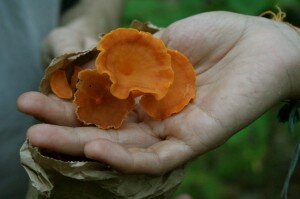
Yellow foot chanterelles - one of countless gourmet species currently fruiting in the Northeast!
Take a load off my fanny pack. Take a load for free.
That just about sums up how I felt as walked out of the woods yesterday, my back almost crumbling under the weight of innumerable mushroom-filled paper bags.
Fortunately, I have plenty of friends who are always more than willing to lighten my load. On the way back from the foray I picked Jenna up at our neighborhood coffee shop, where I traded mushrooms with a baker friend for just out of the oil fried dough.
Before I had even left the café I received a call from another friend eager to claim his share of the bounty. I told him to meet me back at my home, where the selection would be even greater. He didn’t waste any time, arriving, soaked in sweat, within minutes of my return.
In Ithaca, all the fall mushroom species are out in full force. Had it not been for the black trumpets, lion’s mane, porcini, yellow feet, hedgehogs and blewits weighing me down on yesterday’s hike, I actually might have stopped to pick a few of the thousands (literally) of honey mushrooms and hundreds of aborted entolomas I saw along the trail. I don’t have anything against these mushrooms, but it’s hard to get excited by ground beef when you have unlimited free filet mignon!

Northeastern ForageCast for the week of September 27, 2011!


Deeply jealous! We’re getting more rain here, so I’ve had my fingers crossed there will be a bounty in the woods this weekend.
I noticed you have yellow foot listed with the greek name Craterellus Ignicolor. I have been a bit confused by this and Craterellus tubaeformis as of late. I live next to an awesome swamp and find what look’s like an all orange black trumpet (though bigger around the margin) much like the mushrooms you have in your picture, and another mushroom that I am 100% sure are Craterellus Tubaeformis, they have a bright yellow stem, and distinctly brown cap, with false decurrent gills, the whole mushroom is more or less hollow and vase shaped. (although the stems are often kind of boxey) I was under the impression that the orange ones were Craterellus Ignicolor, which would only be confirmed by your classification, but my confusion is with the fact that I thought Craterellus Tubaeformis was what is commonly called yellow foot, and have been skipping over the orange ones…………. Hoping you might be able to clear up my confusion.
Tea – Your confusion is understandable. First of all, these species are the subject of mycological debate around scientific names. Secondly, C. tubaeformis’ scientific name was hiding from the ForageCast graphic! I had included this name, but it was accidentally lopped off the bottom of the graphic. Now it is back! Next week, I may add a photo of C. tubaeformis, with its brown stem, as well.
To answer your question, both of these species are often called yellow foot chanterelles, and both are equally delicious! Common names are confusing, though, since some people have separate common names for C. ignicolor and C. tubaeformis (such as and flame colored chanterelle and winter chanterelle). I conveniently refer to them both as yellow feet. Feel free to post photos to our FB wall to confirm ID, but it sounds like you have been eating C. tubaeformis and finding C. ignicolor. They look practically identical, except that C. tubaeformis has a browner cap and slightly browner tones overall. The mushroom currently in the icon is C. ignicolor, with its yellow-orange cap and (brighter) yellow stem. Hope this clarifies things!
Glutton for Life: Where are you located? I’m sure there will be a bounty; you just have to find it! Keep me posted about the fruits of your forays!
Im in Sullivan County on the Delaware River, considerably south of you. Thanks to you I recently picked up my first lion’s mane, and yesterday found a chicken mushroom right in my back yard!
Yes, it certainly helps, now if I could just add to the confusion a little more. If I find Craterellus Lutescens/Xanthopus/Aurora ( I am assuming these names all refer to the same mushroom) Where do they fit in? Are they also a yellow foot, and good to eat?
Tea – Glad that helps. C. aurora is often referred to as “yellow foot” as well (alas, why common names alone are insufficient), though I don’t find it as much around Ithaca. Your swampy habitat would be a good place to look, though. It looks a lot like the other yellow feet – the cap starts off brownish, but becomes yellowish as it ages. The crucial distinction is the underside – C. aurora has a fairly smooth bottom which often has wrinkles or a veiny look, but does NOT have well-developed false gills like C. ignicolor and C. tubaeformis.
Glutton for Life – Glad you’re finding the ForageCast helpful. You probably are a week or two ahead on the spring and summer mushrooms, and a week or two behind on the fall species whose fruitings are triggered by colder temps. It’s always fun to find mushrooms right in your backyard – chicken mushrooms often fruit from the same tree year after year, so now you have your own private patch!
How about a 8.8 lb Grifola frondosa found at the base of a live white oak? Glad I wasn’t too far from the car! Has anyone sold fresh mushrooms?
Larry, nice find! I have not sold fresh mushrooms; I know the law around it is a bit murky in NY. Maine has established a good policy around the sale of wild mushrooms and is a leader in this area.
Just found your site, it’s great! Just started foraging 3 years ago so still have sooo much to learn. Definitely can learn a lot from you, will keep an eye on your site come spring-Thank you!!! Shaun, Sullivan County NY
Shaun, I’m glad you discovered The Mushroom Forager, and I hope you continue to find the site useful. Thanks for your comment!