Nothing beats the deep delight of finding a morel (or two!).
Northeastern foragers, watch out – the mighty morel is marching your way at a staggering rate! Morels are already fruiting in West Virginia and Ohio, and I expect them to arrive in southern Pennsylvania within the next week. This means morels should be fruiting two to three full weeks ahead of schedule throughout most of the region.
So what does this mean for our new state of residence, Vermont? The first morels typically fruit in southern Vermont the first week of May, arriving in Chittenden County about a week later. This year, I will start looking for half free and black morels the first week of April if this current weather pattern continues. By the first week of May, I wouldn’t be surprised if blacks had come and gone and yellows were peaking throughout the Green Mountain State. My predictions do come with a disclaimer: morels fruit when and where they please. Just when you think you finally have a good grip on their fruiting habits, they may throw you for a loop.

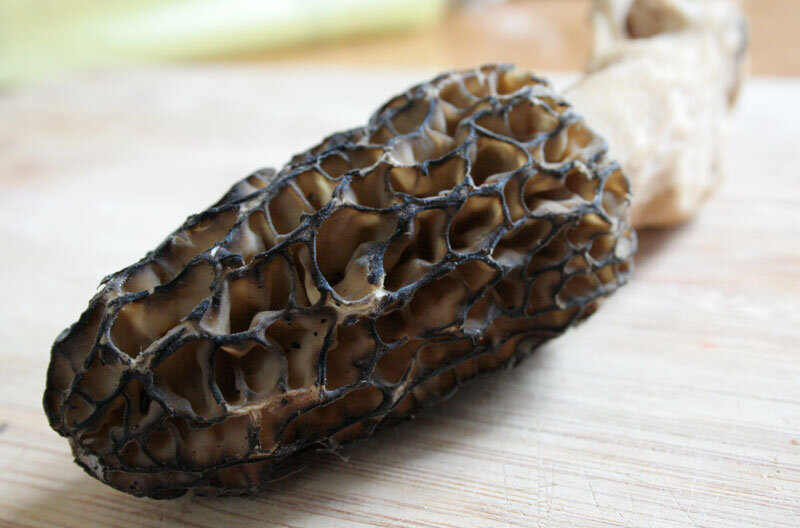
- Found on May 2nd in Ithaca, NY, this black morel was my first find of 2011. Despite being further north, I expect to find the first black morel earlier this year.
Just because morels are arriving early this year does not necessarily mean foragers should expect a bumper crop. In fact, though I am certainly hoping for many a morel feast this spring, I am quite concerned about this season’s harvest.
Morels favor days with highs around 60 and lows in the lower 40s. We have already had a couple 60 degree days in Burlington, and next week’s forecast calls for temperatures hitting 80! Theoretically, a morel in a warmer Vermont microclimate could fruit any day now, but common sense says there is no way we will see morels in Vermont for at least another couple weeks.
By then, will local temperatures be too warm for morels to fruit altogether? Morel fruitings depend on a delicate and enigmatic balance of timing, temperature, nutrition, precipitation, and carbon dioxide levels, so it is easy to imagine this spring’s bizarre weather interfering with the 2012 crop.
Then again, the capricious nature of global warming may demand we throw all notions of “common sense” regarding seasonality out the window, so who knows? Perhaps a tiny morel primordia is already forming near the base of an old apple tree somewhere in the depths of Vermont.


OMG, I am in Hawaii on vacation and panicking that I might be missing morels fruiting in 70-degree Sullivan County (upstate NY) already!! Can you please post some pointers on where to look for them as I had no luck in old apple orchards last year? Thanks!
Not to worry, Gluttonforlife, morels have not yet arrived in NY. Come home soon, before it’s too late! I would look near dying elm and ash trees, as well as in beech and sycamore woods.
What does it’s poisonous counterpart look like? My grown children prefer I do not pick wild mushrooms as so many fatal mistakes have been made, even by those in the field. Unfortunately, there are no clubs anywhere near me so I could have the opportunity to educate myself about this appealing idea. My summer property is filled with a miracle of mushroom varieties which go uneaten.
Beverly, We are going to post an article with some info about the poisonous counterparts soon. There are a few look-alikes to watch out for, but once you learn the difference you would never confuse them. While it is very important to be prudent when it comes to mushroom foraging, the practice can be extremely safe if you take the time to learn your mushrooms one by one. Stay tuned to the blog’s ForageCast this year, which highlights the safest and most distinctive species in season in the region. Start with the easiest species, like lion’s mane and chicken of the woods, and gradually increase the scope of species you are comfortable with. Knowledgeable foragers should never make mistakes, fatal or otherwise. I have never even gotten a belly ache from eating wild mushrooms, since I never eat anything unless I am 100% certain. The key is to know your mushrooms, and to know the limits of your knowledge. Feel free to post photos of your finds to the blog’s Facebook page, and I will be happy to help you ID them.
In central ontario by peterborough we find them growing along the side of dirt roads. only the yellow morels, we have yet to find any black morels gorowing on the sides of the roads. By the way , great article you guys wrote there!!!!!!!!!
Just moved to upstate NY (Saratoga Springs) Navy brought me up here, curious to when I should start looking?
Ryan, we’re glad you enjoyed the article! Make sure you watch out for contaminated soils if you are picking roadside morels. I find they definitely do enjoy disturbed habitat.
Steve, I would start looking in a couple weeks; stay tuned to the blog for updates on the morel progression!
Love the article. New to Olean and am looking for fellow shroomers to go with. I grew up in central Il. mushrooming was great there, did it every year for 20 yrs. Found them alot around dead elms, there were alot standing dead from dutch elms disease back then. I am so looking forward to the season.
Hello! I have been an avid forager and a poor speller for years now. I grew up in nortern vermont, and moved to washington st 3 years ago. In the spring time there we would travle up to Stevens pass in the Cascsade mountains. We would follow the snow melt line and find half free, as well as the trophy snow drift morels, averageing about a half pound each! and So tasty! As the spring turrned to summer, the black morels would sprout in the dessert sands in western washington.
Now that i am back in Vermont, i have great places for black trumpets and golden chanterelles, but never have found my much missed morels. I have looked in old apple orchards in the islands, and all around chittenden county. Please help! i miss this tresure of the spring and now my childeren are older would like to make it a family affair. Thanks!
Greg, I hope you have a very fruitful foraging season – keep us posted about your finds!
Brent, I would love a trophy snow drift morel right now – thanks for sharing your stories of foraging out West. Morels are very hard to find in the Northeast, which makes the experience even more magical when you finally do discover a patch. I would keep looking – persistence pays off! In addition to old apple orchards, look for dying elm and ash trees, or try looking near beech. Good luck!
enjoyed the article(daughter lives in Vt) I live near Reading Pa and thought I would check. Found about 10. It is about three weeks early for me. we well be in South Roylton VT april 6
Bob, Wow – it is exciting to hear that morels have established firm ground in PA. It is unlikely, but who possible, that morels will have arrived in S. Royalton by 4/6.
We’ve been “Scouting” locations all winter. Today, my partner showed me an ancient apple orchard she found overgrown with poplar, ash, maple, elm and beech on a south facing slope. Most of the apple trees are decomposing.
She’s been watching the march north and with today’s rain it was hard for her to give up the fact it’s still too early.
Sweeper, Sounds like a prime morel spot – keep me posted and feel free to share photos if it is as fruitful as expected. What state are you in?
Partner’s in Central MA, I’m in SW NH
Hi
First timer for morels in 2012, mostly a fall picker….
Any tips or comments about Connecticut?? Dead elms are easiest to spot when the rest of the trees are starting to turn green, just about the END of morel season…so Im putting more effort into apple orchards……
Nice post……thank you.
Folks who pick in old orchards need to realize that the preferred insecticide in the old days was Paris green, a form of arsenic which settles into the soil and remains there for a long, long time. This was replaced in the 1930s to the 1950s by lead arsenate, also persistent. There have been cases of illness from consuming morels from old orchards. If you have a favorite old orchard for morel hunting, it wouldn’t hurt to test the soil! See http://www.fungimag.com/winter-08-articles/Rev_Medicinal.pdf
NCK, I’d start looking in the next week or two for blacks and early yellows in CT. Cottonwoods can also be hosts to blacks, and always keep your eyes open for old ash trees – common hosts of both blacks and yellows. Until you have found producing spots to return to in following years, you’ll likely be doing a lot more looking than finding, so be ready for an epic adventure. When you find the reward, it will all be worth it!
Bruce, Thanks for your comment. I had heard about this story and, though they were unable to definitively link his arsenic poisoning to the orchard morels he consumed, I definitely would advice people to be prudent. If you pick from the same old orchard(s) year after year, it is certainly worth testing the soil – it is easy and inexpensive to do so, and nobody wants to be eating lead or arsenic.
Went today…..quick check of abandoned apple orchard, many ash trees, a few tulips, even around some skunk cabbage (recommended by Ms Land’s husband)….nada…BUT, it was raining….which I’ve got to believe is really needed after a snowless winter.
NCK, glad to hear you’re getting out there. The rain should certainly be helpful – it’s still a bit early, though we’ll see what this rain brings…
i have been morel hunting in MA, but havent seen a thing yet, let me know if they start popping up
I have a few acres of land in the Finger Lakes (that’s upstate NY, for those of you who may not know), and I have seen what looks like Morels, but I am not 100% sure. Any suggestions/help from anyone? I love foraging and can’t bear the fact that I am not eating these mushrooms (if they are truly Morels). AT
Hi Tony, Feel free to post a photo of the mushroom on our Facebook page. There are some dangerous look-alikes to watch out for, but I can easily distinguish them from a photo.
We just moved to beautiful Putnam Valley walking distance to Lake Oscawana. I was raised to stay out of the woods in the spring until the beloved morels came up. I’m hearing that Morels are found upstate but would love to know if they grow in my area and what trees I should be looking for. Also, when to start looking since we are in the mountains and the temperature is always ten degress cooler here than down county.
Any help and pointers would be so much appreciated. Last year, we drove all the way to Charleviuox, Michigan to pick!
Ellen, Morels are certainly found in your region, though they can be very hard to find throughout the Northeast. I would start looking in the next couple weeks or so, when it seems like daytime highs are hovering around 60 and the ground is sufficiently moist. Look under ash, elm, and old apple trees but remember, morels are unpredictable by nature!
Went again yesterday……..basically elm trees, to me, are unkown. Its tough enought to find and elm tree period. But I HAVE FOUND them. BUT, then they have to be dying……that cuts the choices down, and then dying or dead, BUT NOT MORE THAN 3 YEARS……I mean…….maybe, MAYBE, there are 7 or 8 elms trees in the entire state of Connecticut that matchest those criterias! So, I’ve expanded my trees, mostly ash, tulip poplar, apple orchards (and I read they have to be bigtime overgrown to be a good spot, not just abandoned….have you ever SEEN an overgrown apple tree? Electric shears..thats what you need…and extension chore a couple miles long) and sycamore…along with path edges……..not one. Not even close. THis is my first year for morels, Ct ain’t exactly a haven for them, so I pretty much understand I might get skunked…I accept that. I HOPE we get the rain we are supposed to this week!
Bill Yule posted that the NW section of the state is the most likely area of CT to be home to more than a few morels….so I’ll go out this week and find a few spots that I will revisit in May.
Thanks for letting me vent.
Nick, Sounds like you are in for an adventure this foraging season. Older/dying ash trees are excellent hosts for both blacks and yellows, and may be easier to find than dying elms. When it comes down to it, however, morels fruit whenever and wherever they desire, so I wouldn’t get too bogged down with the rules of typical morel hosts. I have found good morel patches that don’t meet any of the typical criteria, and likewise, even a dying elm forest is not guaranteed to bear fruit. Morels should be coming into season in CT soon provided you get enough rain – my best advice is keep your eyes open and be up for a bit of an epic quest the first year. Once you find proven morel patches, it will be much easier (though still not guaranteed) for you to repeat your success in future years.
Found the first morel of the season in Syracuse, NY on Earth Day, April 22!!! Whoo-hoo! Game on!
Yeah, Tom! Glad to hear you were successful. Just a lone morel? I still haven’t found any up in Burlington…staying busy with fiddleheads for now!
Found our first 2 blacks of the season, which come up alongside a driveway, 1300 ft, near the Rte 100 corridor in southern VT. This spot has yielded up to 20 in previous years.
Surrounded by spruce and birch, – no elm, ash or apple anywhere close at hand.
I’m a little nervous about the prospects for this season due to the roller coaster weather- tonite and the next few well below freezing. And although I know of one other location which was shown to me, I have never found others in this area despite some regular searches of areas supporting ash, dead elm and apple orchards.
Skunked again….found SOME mushrooms at least, first of the season.
A brown cup
collyria cookei
And a water logged gilled variety I have no idea.
So, at least SOMETHING is beginning to grow.
But, my God, I haven’t spotted a single morel…..have searched mostly ash and tulip trees, as well as starting to look in apple orchards…nada.
I’ve come to realize that for me to spot my first one ever, it will have to be rather large, located in a fairly open spot and just plain lucky. Until I get to know some “spots” (which every post I read on shroom sites, mentions that the morels were found on a certain spot that had yielded morels in previous seasons), its gonna be look and look with lots of luck.
Any word on COnnecticut findings?
Nick
Nick, I’m happy to hear you at least found some signs of fungal life! Still no morels for me, either. I’m in a similar situation – since this is my first season in VT, I don’t have any proven spots to check. A lot of trial and error for sure – but hopefully both of us will prevail eventually! Morels are definitely currently fruiting in CT – trouble is finding ‘em!
I am currently watching and photographing 14 morels… ..i spotted about 9 or ten only about an inch tall pretty small and grey …then about 25 yrds from that i find 3 about 4 inches tall and fat , these are yellow .. real healthy types … these were all found within 2 acres of eachother . it is sunny and 65 degrees here now … but it has been dreary , misty and rainy with cool to down right cold here in st lawrence county ny … i am excited … i will pick a few today … and hopefully spott some more. they seem a little late this season … compared to last few years … i have photos of last 3 yrs and this also … i will try and get them attached . mmmm mmmmm mmmmm….. asparagus patch is doing well and leaks were and are striving here … but leaks = less than previous yrs …. hmmmmm. i ‘ll keep in touch … good luck all.keep your eyes to the fungi.
Hey Nick, I am new to foraging and also in CT. i have done numerous searches as well for morels, last season and now with no luck. Still really dry hereand hoping after some rain today maybe checking again tomorrow, these things gotta be somewhere around here, Im sojealous of everyones pics! Theonly thing I have harvested for the past 9. Yrs are the Fiddleheads and yes they do exist here altho theyare. Out of season now:( not sure of your location but next Spring head towards Kent and take a walk along the housatonic river you will have a great time even if you dont locate any Fiddles, but they are there:), Now for Ramps, I too found my first batch this year :). Need to head out and gather more before its to late…..Sorry for the long post, lol I just got excited there was finally someone in CT looking for Morels and not just me, Good. Luck on your hunt would love. To hear back with your succes.