We hope you’re as excited as we are about the upcoming Northeastern mushroom foraging season! While you wait patiently for morels, in the mean time you can get excited about the 2012 workshop season with The Mushroom Forager. This upcoming week, The Mushroom Forager’s 2012 workshop season will be kicking off with a fun-filled workshop at the Horticulture Society of New York in New York City called Mushrooms Wild and Cultivated. Participants will be introduced to the region’s most distinctive and delicious wild mushrooms, as well as inoculating a shiitake log to take home.
We’re also looking forward to two workshops in Western Massachusetts – a mushroom cultivation and foraging workshop in Montague on May 12th (just a few seats left, so register while there is still space!), and a foraging lecture and guided walk at the 2012 NOFA Conference in August. Between May and August, there are a handful of workshops scheduled in Vermont at the Metta Earth Institute, Shelburne Farms, Twin Pond Retreat and the Center for Whole Communities. We are excited to be collaborating with our friend Steve Gabriel of Work with Nature for two of these workshops.
If you aren’t able to join us for any of these events, stay tuned as there will likely be additional workshops added to the 2012 schedule. Please visit our Upcoming Workshops page to learn more about our workshop offerings and our Testimonials page to get a flavor of what past workshop participants have said about The Mushroom Forager. We hope the foraging season ahead fills your baskets with a cornucopia of wild treats!

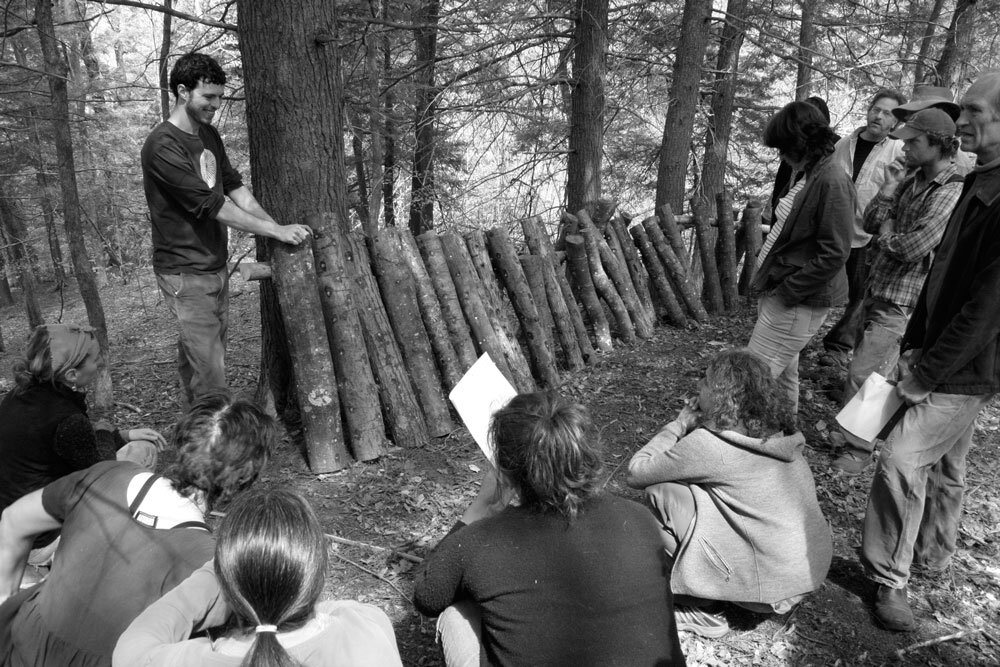
On left: Workshop participants inoculate a log with shiitake spawn. On right: Ari leads a workshop on mushrooms in the garden at the Ithaca Community Gardens in 2011.


I’d love to be able to get into growing my own Shiitakes, in NY. I use to in Florida, but it appears laws here are weird. With the invasive species threats the county I live in, as well as the neighboring counties have quarantines with moving untreated wood, as well as a statewide law with moving wood more then 50 miles. Is there a way to “reconstitute” heat treated (kiln dried) lumber to use for inoculation?
Sadly, I rent, and I’ve yet to find a local source for logs, and I’ve asked around quite a bit, with no luck at all.
small clarification, I’m not asking about kiln dried construction lumber, but more along the lines of the commercially dried firewood that you can buy from places like lowes, and gas stations.
Dusty: Unfortunately, I don’t believe there is a way to reconstitute heat treated lumber for inoculation. Logs used for shiitake inoculation have to be fairly fresh (cut within the past couple months) and need to have adequate log moisture content in order to be a viable host for shiitake. You could experiment with soaking heat treated lumber for 24 hours in water and then inoculating, but it is unlikely this would work. If you do try this, I’d be curious to hear your results. I would only try this with a few logs, though, given the unlikelihood of success. You’d have to make sure the logs you are getting are hardwood species, too.
Where are you located in NY? If you have any friends locally who own woodlots, you could ask if you could hire someone with a chainsaw to cut down some hardwood logs with 4-6” diameter. If they harvest trees selectively, it can actually be beneficial to their woodlot by giving bigger trees more room to grow.
I’m located just outside of Hudson NY. The problem is, with the regulations put in place to stop the spread of Emerald Ash Borer, most of my sources for wood (even seasoned wood to burn in my stove) fall either within or directly opposite of a quarantine zone.
(NY quarantine map) http://www.nyis.info/?action=eab_maps
I still have some seasoned hardwood that did not get burned this past winter that I’m going to attempt inoculation with, I’ll try soaking it for a day, as you suggested.
Will 4-5″ diameter maple work well? I was looking at inoculating Shiitake, which I’ve done before, and maitake & oysters, which I have not done before.
What we did in Florida was use 12-14″ diameter oak (with shittake) But if I can use smaller diameter maple, I may be able to convince my landlord to let me take down a few branches off some Irene damaged maples on the property.